
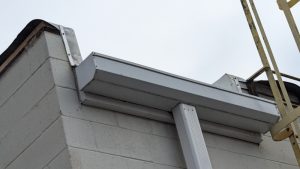
Box gutters sit inside the roof structure rather than hanging off the fascia. That position gives them a clean, integrated look that older Dallas homes were built for. It also means that when something goes wrong, the damage hides.
A standard K-style gutter drips visibly when it fails. A box gutter leaks directly into the wood framing beneath the channel. By the time water stains appear on a ceiling, the damage has often been building for months. Paint peeling along the roofline tells the same story.
Knowing what to look for, and what each sign tells you about the condition of the system underneath, is the difference between a targeted repair and a much larger project. These are the seven signs that a box gutter needs professional attention, along with a clear read on repair versus replacement for each one.
Sign 1: Water Stains on Interior Ceilings or Walls
This is the most critical sign on the list, and the one most often mistaken for a roof leak. When a box gutter liner cracks or a seam opens, water escapes into the roof structure directly beneath the channel. It travels along the rafters and into the ceiling or walls of the room below.
The stain on your interior drywall is not from rain penetrating the roof deck above it. It is from the gutter running parallel to it, at the same level.
Interior stains from box gutter failure typically show as brown or yellow rings on ceiling drywall. They appear near the outer wall of an upper-floor room. Bubbling paint, soft drywall, and a musty smell in the same area all point to the same source.
The reason box gutters produce interior stains where standard gutters do not comes down to position. A hung gutter that leaks drips off the fascia and falls outside the house. A box gutter that leaks deposits water into the structural cavity it is built into.
Repair or replace? If the liner has one or two isolated failures and the wood framing beneath it is still dry and firm, a targeted repair is usually the right call. If the framing has absorbed enough moisture to soften, the repair has to address the wood first. New liner sealant applied to softened wood will fail quickly.
Sign 2: Soffit and Fascia Damage Visible from the Ground
The soffit, the horizontal surface under the roof overhang, sits directly below the box gutter channel. It is one of the few places you can check from ground level for evidence of a leak above.
A healthy soffit is dry, uniformly colored, and structurally firm. Dark water staining, bubbling paint, or visible sagging on the soffit tells you that water has been escaping the liner. The material beneath the soffit has begun to saturate.
Fascia boards along the roofline show similar evidence. Peeling paint on fascia near the gutter channel indicates water is wicking into adjacent wood. Wood that has turned gray or soft at the roofline tells the same story. AMS Gutters handles soffit and fascia repair alongside box gutter work, because these two problems arrive together far more often than not.
If the soffit or fascia material feels soft when pressed, the leak has progressed beyond the surface. The supporting wood behind it has begun to break down.
Repair or replace? Early discoloration without structural softness often means the liner is the primary problem and is still repairable. Once the wood behind the soffit or fascia has softened, the scope expands to include carpentry work on the roofline. At that stage, a full restoration or replacement is typically more cost-effective than patching alone.
Sign 3: Standing Water Inside the Gutter Channel
Box gutters drain through an outlet connected to a downspout. When that outlet clogs, or when a section of the channel has shifted and no longer slopes toward the outlet, water sits in the trough between rainfalls.
Standing water accelerates liner deterioration. It keeps the liner material wet continuously and pushes against seams under static pressure. Seams built to handle flowing water are not designed to resist pooled water pressing against them for days at a time.
You can sometimes spot standing water from an upstairs window or a ladder. More often, the evidence shows as algae or organic staining inside the channel, which appears when water has been sitting long enough to support growth.
Dallas box gutters collect shingle granules, live oak debris, and acorn residue in quantities that compact at the outlet without blocking the full channel. The downspout may look clear from the street while the outlet itself is effectively sealed. Regular gutter cleaning prevents this specific failure, which is why professional cleaning and inspection belong together.
Repair or replace? If the outlet is clogged and the liner and wood are sound, a professional cleaning resolves the problem. If the channel has lost its slope, re-attaching it to the roof framing at the correct pitch is the right fix. This is more involved than a cleaning but well short of full replacement when the liner and framing are still in good condition.
Sign 4: Cracks, Gaps, or Rust at the Liner Seams
The liner is the waterproof layer inside the box gutter channel. It is the primary barrier between the water flowing through the gutter and the wood structure the gutter is built into. Liners are typically made from galvanized steel, lead-coated copper, or an elastomeric coating, and they degrade through two main mechanisms.
The first is thermal cycling. Dallas regularly sees daytime highs above 100°F in summer and overnight lows below freezing in winter. That temperature swing causes liner material to expand and contract repeatedly, opening micro-cracks at seams over years of use. The second is oxidation, which produces rust on steel or galvanized liners once the protective coating thins.
Cracked seams and rust holes do not drip visibly. Water escaping through them enters the wood framing, not the outside air. A direct inspection of the channel reveals discoloration at seam lines and hairline cracks in a coating liner. On metal liners, rust shows as orange-brown spots, often starting at a seam before spreading across the surface.
AMS Gutters inspects the full length of every channel as part of its box gutter repair and restoration process, not just the location that triggered the call.
Repair or replace? Isolated seam failures on an otherwise sound liner respond well to reseal and recoat. If rust has spread beyond a localized area, or if cracks run along multiple seams, the liner has reached the end of its service life. Resealing one section of a liner that is failing throughout buys time measured in weeks, not years.
Sign 5: Paint Peeling or Dark Staining Along the Roofline
When a box gutter leaks where the channel meets the exterior wall or roof edge, water gets behind the siding or fascia before it drains. That trapped moisture pushes outward as vapor pressure and lifts paint from the surface it is trying to escape through.
Peeling paint along the roofline of an older Dallas home, especially paint that comes back within a year or two of being redone, is a reliable indicator of a failing box gutter nearby. The paint failure is not the underlying problem. It is moisture behind the surface looking for a way out.
Dark vertical staining on brick or stone directly below where a box gutter runs is a related signal. Mineral deposits left by water trickling down masonry over time produce a stain pattern that traces the leak point above.
Repair or replace? Paint failure and surface staining at an isolated location usually correspond to a single leak point. A contractor can identify the failing seam or crack and address it before repainting. If the failure runs the full length of the roofline, the liner has multiple failure points, and restoration or replacement is more economical than spot repairs followed by repeated repainting.
Sign 6: Water Pooling Near the Foundation or Mildew on Exterior Walls
A working box gutter carries rainwater from the channel to a downspout and deposits it several feet from the house. When the system fails, water ends up where it was not designed to go.
Soil that stays wet along the foundation after rain has stopped tells you the drainage chain is broken. Pooling directly below the downspout extension confirms the same. Mildew or algae growing on the exterior wall below the roofline tells you water is running down the siding rather than being contained in the gutter. This pattern produces a dark streak on brick, stucco, or wood siding that typically begins at the roofline and runs straight down.
Foundation pooling is the most consequential downstream problem from failing box gutters. Persistent saturation around a foundation can cause soil to shift under the slab. This can crack concrete and destabilize the framing above. The cost of preventing that outcome with timely gutter repair is a small fraction of the cost of addressing it after it has happened.
Repair or replace? Foundation pooling tells you the system is not functioning, but it does not tell you why. A professional inspection locates whether the failure is a blocked outlet, a liner crack, a downspout connection problem, or a slope issue. The repair or replacement recommendation follows from what the inspection finds, not from the pooling symptom alone.
Sign 7: Repairs to the Same Spot Keep Failing
If the same location leaks again within two years of a professional repair, that fix did not reach the underlying problem. Good sealant adheres reliably to dry, stable material and holds for years. Sealant applied over damp wood or a shifted liner section fails quickly. The substrate beneath it is no longer stable enough to hold a bond.
A repair returning in the same spot means the wood framing beneath the liner has absorbed moisture. The wood has swelled, shifted, or softened enough to prevent a lasting bond. The liner cannot seal against a surface that moves or compresses under it. The failure will keep returning until the wood is replaced and the liner is reset on a dry, solid foundation.
Multiple patch repairs across different sections of the same gutter run send a different but equally clear signal. When failures are appearing in several locations, the liner has aged past the point where individual repairs are cost-effective. Each new repair that holds is likely to be followed by a new failure nearby.
Repair or replace? A single failed repair at one location points to a wood repair underneath, followed by a new liner application in that section. Multiple failed repairs across the gutter run point to full replacement as the more economical path over a two-to-three-year window.
How to Decide Between Box Gutter Repair and Replacement
The repair-or-replace decision for box gutters comes down to two factors: the condition of the liner and the condition of the wood framing beneath it.
Liner has isolated failures, wood is dry. Repair is the right call. Reseal the seams, recoat the liner, and address any outlet blockage. A well-executed repair on a sound system can extend the gutter’s service life by a decade or more.
Liner has failed along most of its length, wood is dry. Restoration is more cost-effective. A full liner replacement with re-sloping where needed beats spot repairs that will continue appearing elsewhere in the channel.
Wood framing has softened or rotted. Replacement is the right call, and the structural repair comes first. Installing a new liner on rotted framing produces a repair that fails within months. The wood must be cut out, replaced, and fully dried before the new liner goes in.
Age is a useful data point but not a rule. A box gutter that has been cleaned and inspected regularly can remain serviceable for 40 to 50 years. One that has gone a decade without maintenance can fail structurally at 20 years. The actual condition of the liner and wood at the time of inspection matters more than how long the gutter has been in place.
How Often Should Box Gutters Be Inspected?
Box gutters should be inspected and cleaned at least twice a year, once in spring after storm season ends and once in fall before it begins.
Dallas homes surrounded by mature live oaks or red oaks may need three cleanings per year. These trees drop substantial debris in both spring and fall, and the granular material from aging asphalt shingles accumulates in box gutter channels year-round. Homes in Highland Park and Preston Hollow often fall into this category.
Each inspection should confirm several things. Check that the liner has no cracks or rust at the seams. Verify the outlet is clear and the channel slopes toward it. Confirm the soffit and fascia are dry and firm, and that the downspout connections drain freely.
Box gutters that go three or more years without a professional inspection commonly develop seam leaks and outlet blockages. These problems are inexpensive to fix when caught early. Left until they reach the framing, the same issues become structural repairs.
Get a Free Box Gutter Inspection in Dallas
A.M.S. Gutters has worked on box gutters across Dallas for more than 25 years. Every project starts with a free on-site inspection. The team checks the full length of the channel, the liner condition at the seams, the outlet and downspout connections, and the soffit and fascia for any evidence that water has reached the structure.
The estimate covers exactly what the gutter needs, based on what the inspection finds. If repair is the right answer, that is what gets recommended. If the liner or framing has deteriorated past what repair can reliably address, that assessment comes with a clear explanation of why.
If you are seeing any of the signs above on a Dallas-area home in Highland Park, University Park, Preston Hollow, Plano, Frisco, or across the metro, now is the right time to have it looked at.